
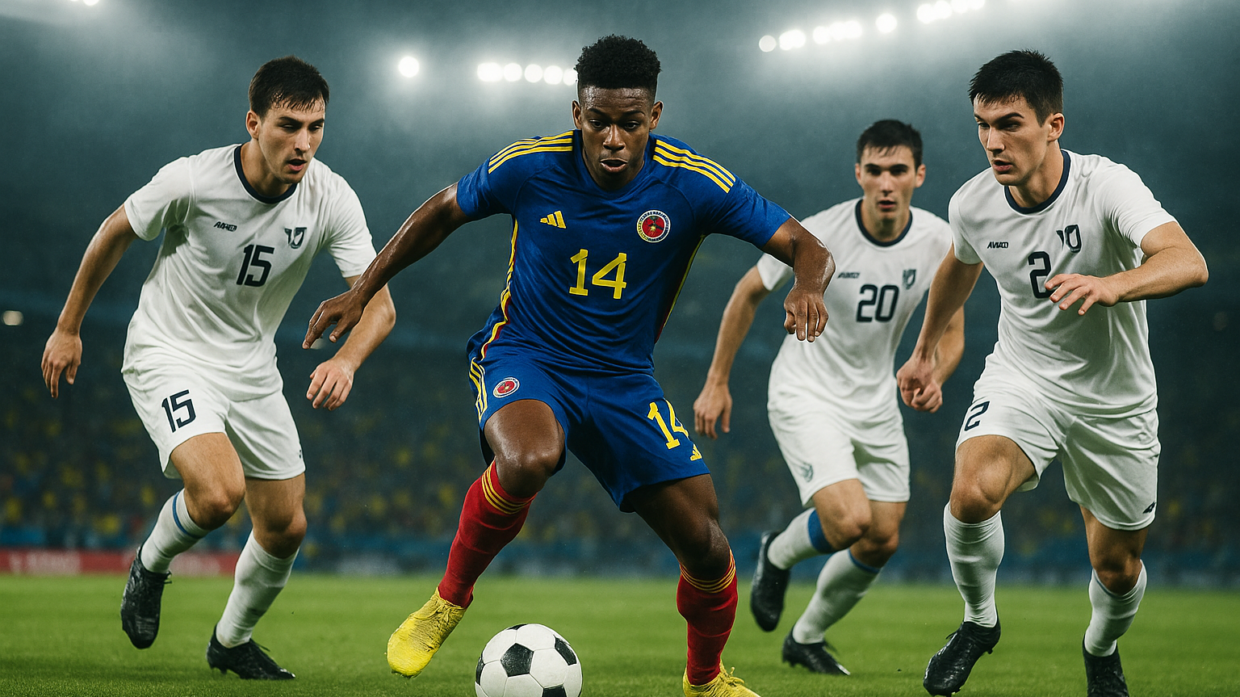
The Breakdown
Colombia enters this Group Stage matchup as a significantly stronger squad with superior recent competitive experience and a more established World Cup pedigree. Uzbekistan, while improving as a confederation, remains a tier below Colombia in international football hierarchy. Colombia's last five matches show inconsistent results, but the team has demonstrated resilience in CONMEBOL qualifying where they finished sixth with 26 points from 18 matches, securing their World Cup spot. Their recent form includes victories against Bolivia and Paraguay, mixed results against stronger opponents like Argentina and Uruguay, and narrow defeats that reveal vulnerability but also competitive intent. Uzbekistan qualified through the AFC pathway, finishing second in their Asian qualifying group behind Japan. Their recent matches have been primarily regional competition focused, with limited exposure to top-tier international opposition. This represents a significant gap in match sharpness against elite teams.
Head-to-head history between these nations is minimal. The teams have never met in official FIFA competition. This represents a genuine unknown factor, though Colombia's experience in continental competitions provides tactical advantages. Colombia participated in Copa America 2021 and 2024, reaching finals and semifinals respectively, exposing their squad to consistent high-level competition. Uzbekistan's recent tournaments have been Asian Cup participation and World Cup qualifiers against AFC opponents.
Colombia's attacking capabilities rest heavily on James Rodriguez's creativity in midfield, though his club form has fluctuated. Luis Diaz brings pace and directness from the left flank, while their center-forward options provide varying styles. Defensively, Colombia has shown fragility against sustained pressure, particularly when opponents exploit the flanks. Their fullback positioning has been a recurring weakness in recent matches against stronger sides. Uzbekistan possesses technical midfield players developed through their domestic league system, but their individual player profiles lack the international recognition and experience of Colombian counterparts. Their attacking approach typically emphasizes possession and build-up play rather than direct penetration.
The tactical matchup heavily favors Colombia. Uzbekistan will likely adopt a compact defensive shape, attempting to frustrate Colombia's attacking rhythm through midfield congestion. Colombia should dominate possession and territory while seeking to create openings through width and transition play. The key tactical battle centers on whether Uzbekistan can restrict spaces in central midfield where James Rodriguez typically operates most effectively.
Colombia plays this match in a neutral venue as a CONMEBOL representative, while Uzbekistan represents AFC. Both teams carry equal travel fatigue considerations. Colombia's motivation stems from expectations as a Copa America regular participant, while Uzbekistan faces pressure to prove AFC competitiveness on the World Cup stage. A win immediately positions either team toward potential knockout qualification.
No significant injuries or suspensions are reported for either squad at this stage. Colombia's squad depth provides tactical flexibility and rotation options throughout the tournament. Uzbekistan's squad has less proven depth at international level, making injuries potentially more impactful to their campaign. Colombia's home performances in World Cup qualifiers showed strong results, and while this is neutral ground, their psychological advantage through experience remains substantial.
The Edge
Why Colombia wins
- Colombia's attacking depth and CONMEBOL qualification experience
- Superior individual player quality and international exposure
- Uzbekistan's typical defensive approach limiting their scoring opportunities against organized defenses
Risk factors
- Colombia's defensive vulnerabilities on the flanks exposed by Uzbekistan's wide play
- Potential complacency against perceived weaker opposition
- Recent inconsistency suggesting unpredictable performance standards