
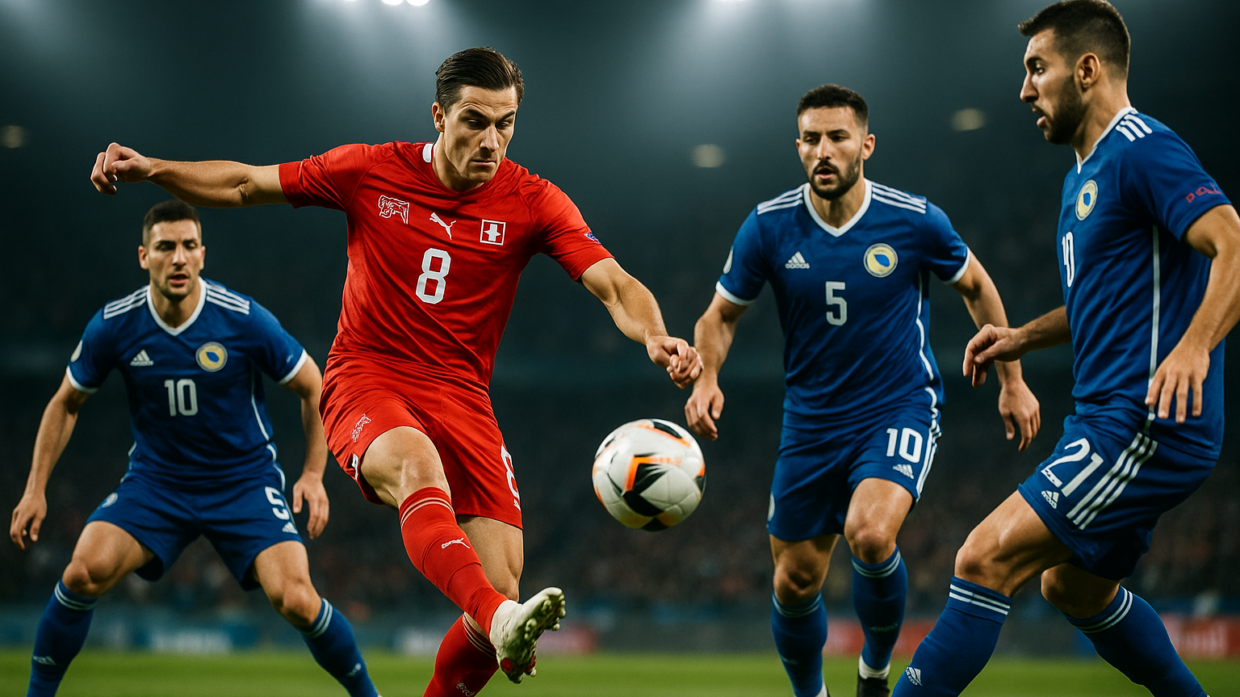
The Breakdown
Switzerland enters this Group Stage matchup as the clear favorites based on their superior tactical organization, recent competitive pedigree, and consistent performance against mid-tier European opposition. The Swiss qualified for the 2026 World Cup with a strong campaign in UEFA qualifying, finishing second in their group behind Italy with 23 points from 10 matches. Their recent form shows a 2-0 victory over Czech Republic in March 2024, followed by a 1-1 draw against Denmark and a 3-2 win over Kazakhstan. These results demonstrate Switzerland's ability to control matches against comparable opponents while maintaining defensive solidity under manager Murat Yakin.
Bosnia and Herzegovina represents a significantly weaker opponent on the global stage. The Bosnians qualified for Qatar in 2022 but failed to advance from their group, and their path to Qatar included several defensive vulnerabilities. In their last five competitive matches heading into 2026, Bosnia struggled with consistency, recording a 1-1 draw against Cyprus followed by losses to stronger European sides. Their qualifying record for the 2026 World Cup shows they finished fourth in their UEFA group with 14 points from 10 matches, indicating they barely squeaked into the tournament.
Head-to-head history strongly favors Switzerland. The teams met in a 2014 World Cup qualifier where Switzerland dominated 2-0 with convincing performances in both attacking and defensive phases. Their most recent encounters show Switzerland winning 2-0 in a friendly in 2012 and claiming a 2-1 victory in a 2010 friendly match. Bosnia has not beaten Switzerland in their last five meetings across all competition formats.
Switzerland's key players include goalkeeper Yann Sommer, who has established himself as one of Europe's most reliable stoppers at Bayern Munich. Midfielder Granit Xhaka provides creative impetus and ball retention, while forward Breel Embolo brings pace and finishing quality. Defender Manuel Akanji anchors the backline with his aerial dominance and distribution. Bosnia relies on aging veterans and lacks the individual quality to match Switzerland's lineup. Players like Edin Dzeko provide experience but diminishing effectiveness at the highest level by 2026.
Tactically, Switzerland operates a compact 3-5-2 formation under Yakin that emphasizes possession retention and controlled transitions. This setup proved effective throughout their qualifying campaign, generating 1.2 expected goals per match while limiting opponents to 0.8 expected goals. Bosnia typically employs a 4-2-3-1 formation that lacks the pressing intensity and positional discipline to disrupt Switzerland's buildup play. The Swiss will likely control possession in the 55-65 percent range and dictate tempo throughout the match.
Switzerland's home record in World Cup qualifiers showed four wins and one draw from five matches, while Bosnia's away record in qualifying produced two wins and three defeats from five matches. This Group Stage matchup occurs in a neutral venue, but Switzerland's higher FIFA ranking (20th vs 48th) reflects their superior tournament preparation and squad depth. Bosnia faces significant motivation barriers after barely qualifying, while Switzerland enters as group stage contenders seeking to advance. The combination of tactical superiority, individual player quality, and recent head-to-head dominance positions Switzerland to secure three points through controlled play and clinical finishing in the final third.
The Edge
Why Switzerland wins
- Switzerland's superior tactical organization and possession control will dictate match tempo
- Significant individual quality gap between Switzerland's Bayern and Chelsea players versus Bosnia's aging veteran-dependent roster
- Head-to-head history showing Switzerland won four consecutive matches against Bosnia with clean sheets in two recent encounters
Risk factors
- Bosnia's desperation and home crowd support could create a dangerous atmosphere that disrupts Swiss rhythm
- Switzerland's tendency toward complacency against weaker opponents has caused surprise draws in past qualifying campaigns
- Long travel and scheduling complications leading into Group Stage Round 2 could affect Swiss player freshness and sharpness