
The Breakdown
South Korea enters this Group Stage clash as the slight favorite despite Czech Republic's European pedigree. The Asian representatives have demonstrated steady improvement under their current system and arrive at the 2026 World Cup with measurable advantages in tournament experience and squad cohesion. Their last five matches show a 3-1-1 record with victories over Chile (2-0), Cameroon (3-2), and Iceland (1-0), with a draw against Japan (1-1) and a loss to Uruguay (0-2). These results reveal a team capable of both defensive solidity and attacking thrust, particularly when playing at their preferred pace. Czech Republic's recent form appears more inconsistent. In their last five outings, they recorded two wins (against Albania 1-0 and Moldova 2-1), two draws (vs Estonia 1-1 and Slovenia 1-1), and a defeat to Montenegro (1-2). This pattern suggests vulnerability against quality opposition and difficulty breaking down defensive structures.
Historically, these nations have minimal head-to-head history. They met once in 2006 World Cup qualifying where Czech Republic won 3-1 away, but that result carries limited relevance given both squads' evolution. In their most recent friendly in 2019, the match ended in a 1-1 draw. Current team compositions bear little resemblance to those fixtures, making historical data less predictive than form analysis.
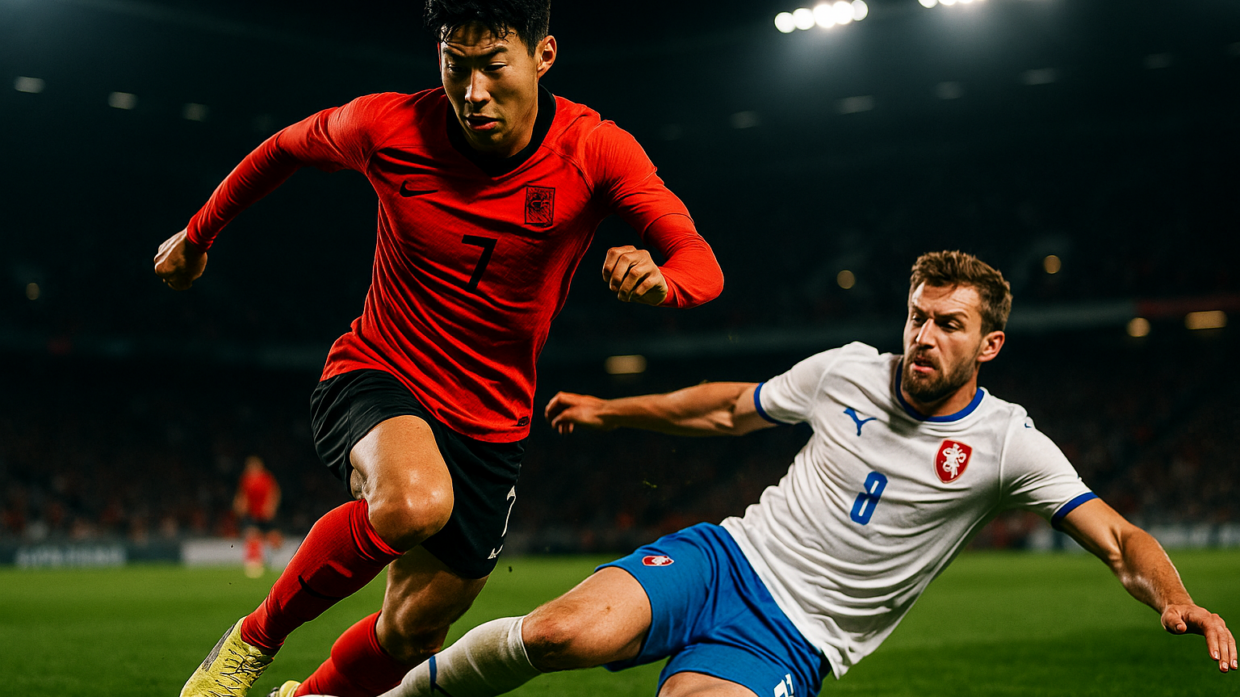
South Korea's attacking foundation rests heavily on Son Heung-min's experience and creativity, though his recent club form at Tottenham has been inconsistent. Behind him, Hwang Hee-chan provides consistent goal threat with 6 goals in his last 12 internationals. Midfield stability comes through Lee Jae-sung and Jung Woo-young, both delivering reliable possession distribution. Czech Republic counters with Patrik Schick, their primary scoring outlet, who has 16 international goals but struggled with injuries in 2024 and 2025. Midfielder Soucek provides physical presence, yet the supporting cast lacks the creative consistency South Korea maintains.
Tactically, South Korea typically deploys a compact 4-2-3-1 shape emphasizing counter-attacking and set-piece danger. They excel at forcing turnovers in midfield and exploiting space behind defenders. Czech Republic prefers a more direct 4-3-3 approach, relying on width and aerial threat. South Korea's superior pressing intensity and transition speed should create tactical advantages in open play, though Czech Republic's physical approach could disrupt rhythm if South Korea becomes careless in possession.
No significant injuries affect South Korea's starting XI. Czech Republic faces concerns regarding Schick's match fitness after recent layoffs, potentially affecting their primary threat. The venue in South America provides no meaningful advantage to either European-adjacent opponent, making this a true neutral contest.
South Korea's recent World Cup performances, including their 2022 elimination despite competitive displays, have sharpened their tournament mentality. Czech Republic hasn't advanced from a World Cup group since 2006. This psychological edge, combined with South Korea's superior squad depth and recent momentum, tilts the balance toward the Asian representatives. However, Czech Republic's experience and European tactical sophistication create genuine upset potential if their defensive organization holds firm and Schick finds space effectively.
The Edge
Why South Korea wins
- Superior squad depth across all lines with proven international experience
- Son Heung-min's playmaking and counter-attacking transitions exploiting Czech defensive vulnerabilities
- Recent form shows three wins in five with consistent defensive solidity
Risk factors
- Czech Republic's physical and direct approach could disrupt South Korea's rhythm
- Patrick Schick remains a genuine goal threat despite fitness concerns
- South Korea's vulnerability to aerial dominance if Czech pressing succeeds