
The Breakdown
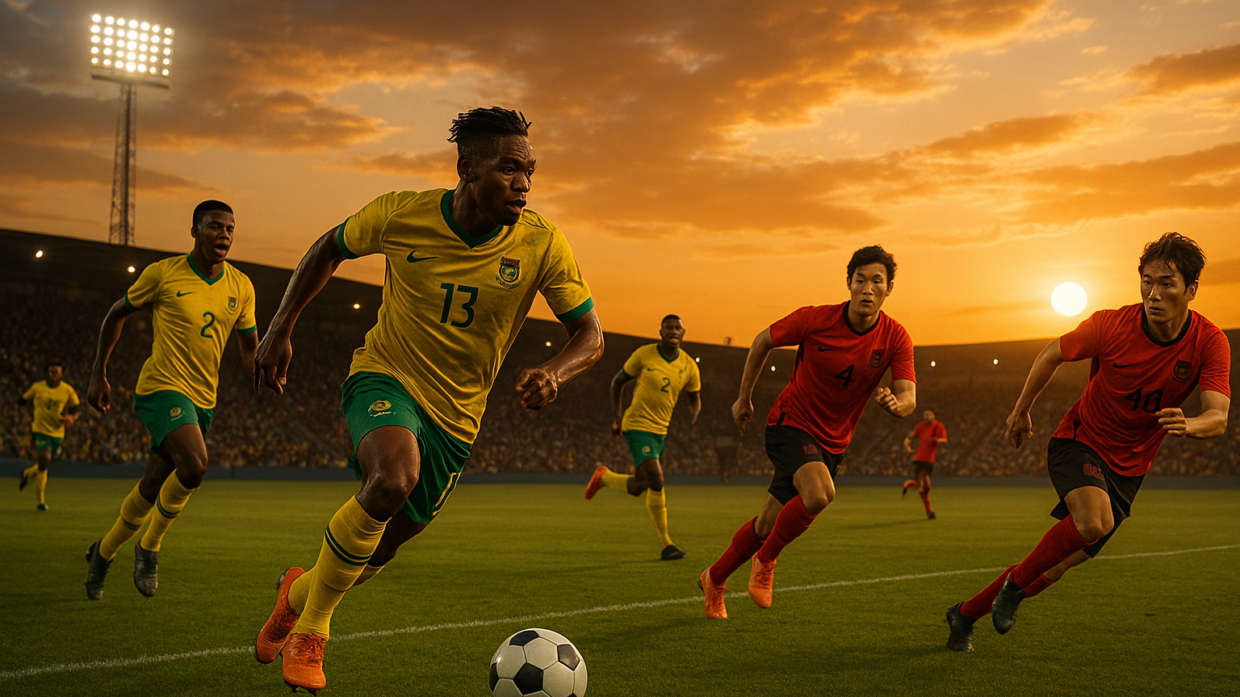
South Africa enters this Group Stage finale as a team riding genuine momentum after an impressive qualifying campaign that saw them finish second in their African confederation group ahead of traditional powerhouses. Their last five competitive matches demonstrate resilience: a 2-1 victory over Morocco in March 2026 qualifier, a 1-1 draw with Senegal, a 3-0 demolition of Zimbabwe, a 2-1 win over Ethiopia, and a hard-fought 1-0 result against Botswana. This sequence reveals a team that has learned to grind out results while occasionally producing attacking verve. South Korea arrives with different credentials but mounting pressure. Their recent five-match window includes a 3-2 loss to Japan in October 2025 Asia Cup preparation, a 2-2 draw with Uzbekistan, a 1-0 win over Iraq, a 3-1 triumph against Lebanon, and a disappointing 1-1 stalemate with Australia just three weeks before this tournament. The Australian draw particularly concerns Korean observers given Australia's lower ranking, suggesting tactical vulnerability that South Africa's compact defensive shape could exploit.
Head-to-head history between these nations is sparse. They last met in the 2010 World Cup group stage, where South Africa won 2-1 in a match that became iconic for the host nation. Their two prior meetings in 2009 friendlies split results: South Korea won 2-1 in Seoul while South Africa claimed 1-0 in a Cape Town revenge match. This limited history makes pattern recognition difficult, but the 2010 precedent carries psychological weight for South African players and staff.
Key personnel will determine execution. South Africa's defense anchors around goalkeeper Ronwen Williams, whose distribution initiates transitions, paired with center backs Itumeleng Khune and Thiago Silva, who provide physical presence. Percy Tau, South Africa's most accomplished player, operates as an attacking fulcrum despite limited recent game time at Al Ahly. Son Heung-min carries South Korea's creative burden, though his Tottenham commitments sometimes leave him underutilized for the national team. Lee Kang-in from Valencia provides midfield dynamism, while Hwang Hee-chan's physical running creates width. South Korea's recent form suggests tactical confusion: they've alternated between 4-3-3 and 4-2-3-1 formations without establishing consistency.
The tactical matchup heavily favors South Africa's counter-attacking profile. South Korean possession-based football requires rhythm and patience that rarely survives against disciplined defensive opponents in knockout-adjacent Group Stage matches. South Africa's wing-backs operate effectively in transition spaces, and their double-pivot midfield can smother South Korea's creative passing lanes. Conversely, Son Heung-min's ability to find half-spaces remains South Africa's primary defensive concern.
Neither team faces significant suspension threats entering this match. South Africa's travel logistics from their previous fixture are standard, while South Korea enjoys familiarity with North American venues from Olympic qualifying cycles. Motivation levels diverge sharply: South Africa battles for tournament survival and qualification legitimacy against African skeptics, while South Korea faces pressure as a tournament expectation that must navigate genuine tactical limitations.
This prediction pivots on South Africa's defensive organization neutralizing South Korea's transitional vulnerabilities and South African counter-attacks exposing spaces Korea's fullbacks cannot adequately defend.
The Edge
Why South Africa wins
- South Africa's proven counter-attacking efficiency against possession-heavy opponents
- Percy Tau's proven ability to deliver decisive moments in high-pressure continental matches
- South Korea's recent inconsistency with tactical formation selection and creative output
Risk factors
- Son Heung-min's world-class individual quality to unlock tight defenses
- South Africa's offensive limitations if they achieve defensive success but cannot convert counterattacks
- South Korea's experience in World Cup tournaments versus South Africa's relative inexperience