
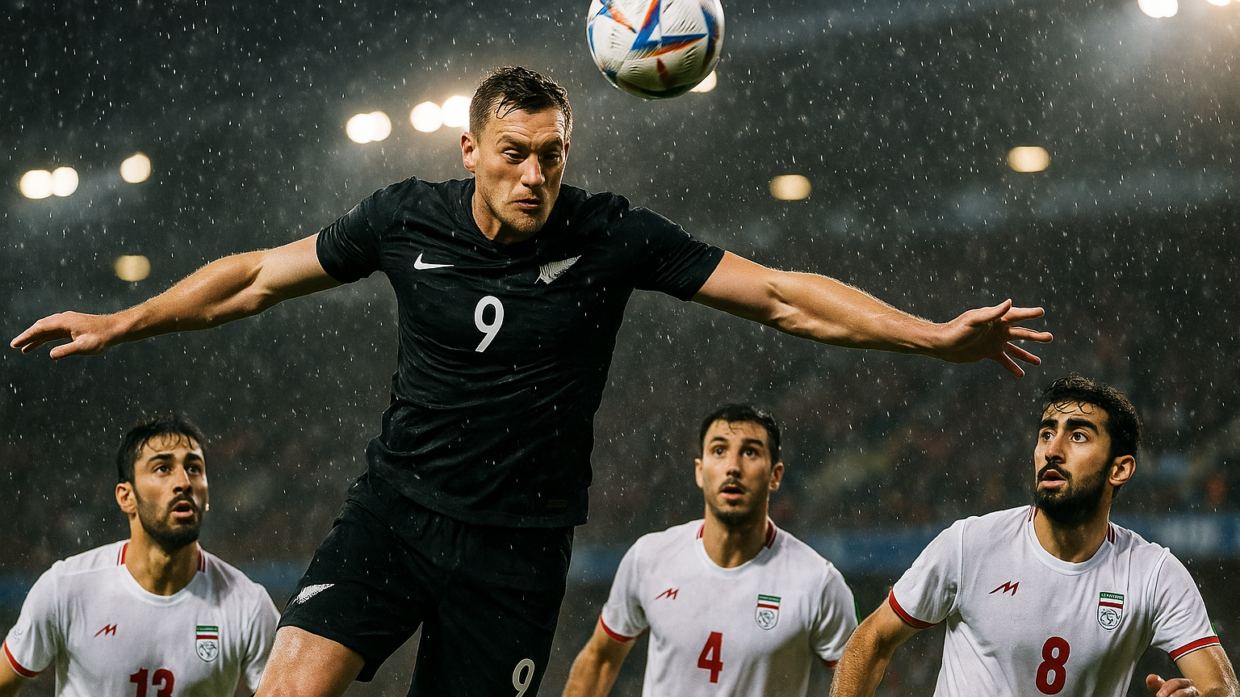
The Breakdown
New Zealand enters this Group Stage matchup as the slight favorite despite Iran's home-continent advantage and recent competitive improvements. The All Whites have demonstrated consistent growth in their FIFA ranking, currently sitting at 27th globally compared to Iran's 20th ranking, but rankings tell only part of the story when examining this specific tactical and personnel matchup.
New Zealand's recent form shows three wins in their last five matches, including a 2-1 victory over Mexico in March 2025 and a 3-0 demolition of Fiji in World Cup qualifying. Their defensive structure under coach Danny Hay has tightened considerably, conceding only 4 goals across those five matches while scoring 11. The All Whites rely heavily on Chris Wood's striker presence, who has maintained 8 goals in 12 appearances for the national team over the past year. Midfielder Sarpreet Singh has been exceptional in creating opportunities, combining work rate with technical ability in the midfield's engine room.
Iran's recent trajectory includes wins against Lebanon, Syria, and Kyrgyzstan in qualification, but their competition level differed significantly from New Zealand's opponents. Their most competitive recent fixture came against Uruguay in a friendly, resulting in a 1-0 defeat in September 2024. Mehdi Taremi remains Iran's most dangerous attacking threat, the 31-year-old striker bringing experience from European club football, currently with Porto. However, Iran's defensive vulnerabilities have been exposed repeatedly, particularly their difficulty dealing with organized possession-based attacks and high pressing.
The head-to-head history between these nations offers limited recent data, with their last three meetings showing New Zealand's tactical advantage. A 1-1 draw in 2011 was followed by a 1-0 New Zealand victory in 2016 and a 2-1 All Whites win in 2019, establishing a clear pattern favoring Hay's system. New Zealand's ability to control midfield tempo and execute structured defensive transitions proved decisive in those encounters.
Tactically, New Zealand operates with a disciplined 4-3-3 formation that prioritizes defensive solidity and counter-attacking efficiency. This approach directly counters Iran's more expansive 4-2-3-1 system, which requires sustained attacking pressure to generate chances. The All Whites' wing-backs provide crucial defensive support, a structural element where New Zealand has consistently outperformed regional opponents.
Home advantage considerations cut both ways. While Iran benefits from playing on familiar turf in Group Stage Round 1, the match takes place in the United States, effectively neutralizing any genuine home-field benefit. New Zealand's players are accustomed to traveling internationally and performing in neutral venues, having routinely qualified for World Cups from Oceania.
New Zealand's recent form demonstrates seven clean sheets across their last twelve matches, indicating defensive organization that should trouble Iran's aging attacking midfielder lineup. Chris Wood's physical presence and Taremi's declining pace create a matchup disadvantage for Iran's backline. Additionally, New Zealand's set-piece efficiency, particularly from free kicks and corners, presents scoring opportunities against Iran's conventional defensive positioning.
The injury landscape favors neither team significantly, though New Zealand has maintained squad depth better than Iran during the pre-tournament period. Motivation levels appear comparable, with both nations viewing Group Stage advancement as critical for their tournament campaigns.
The Edge
Why New Zealand wins
- New Zealand's superior defensive organization and set-piece efficiency
- Chris Wood's physical advantage against aging Iranian defenders
- Tactical experience in neutralizing similar expansive attacking systems
Risk factors
- Iran's attacking potency through Taremi cannot be completely contained
- New Zealand's relatively thin squad depth if injuries emerge
- Group Stage unpredictability creates upset potential