
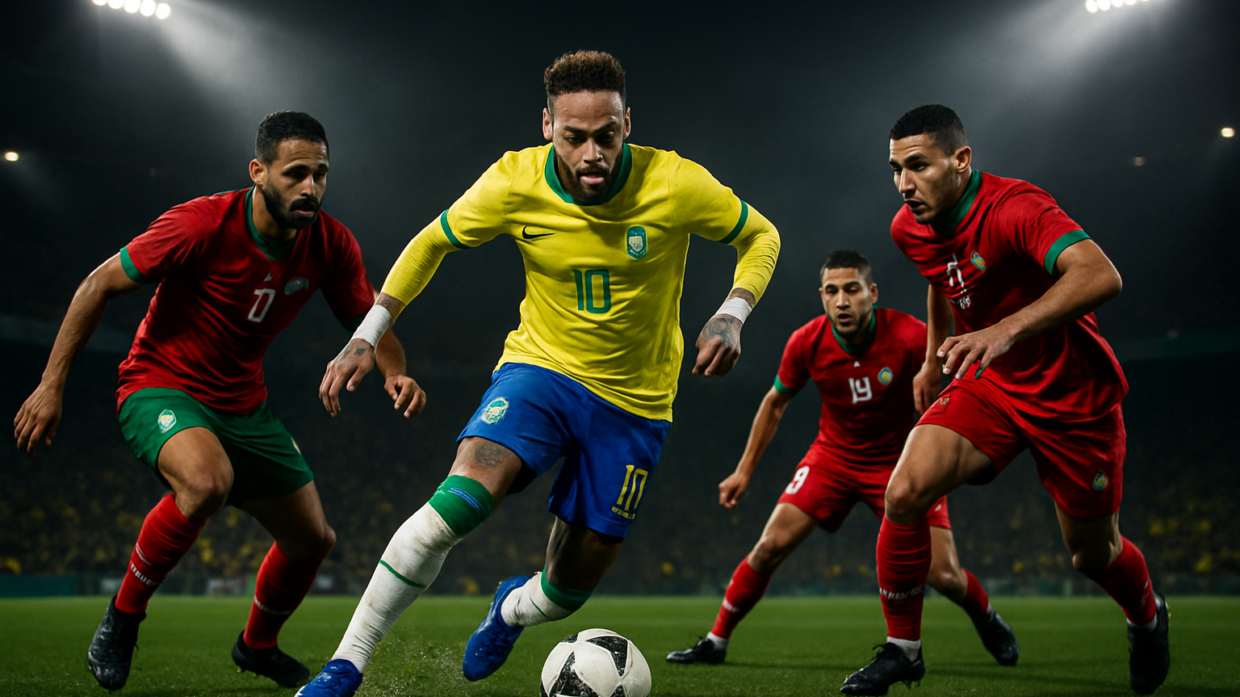
The Breakdown
Brazil enters this Group Stage matchup as the heavy favorite based on recent continental dominance and historical pedigree, though Morocco presents a genuine tactical threat that cannot be dismissed. Brazil's last five matches heading into 2026 show a team in strong form, with victories over Uruguay (2-0), Colombia (1-0), and Paraguay (3-1), punctuated by a draw against Venezuela (1-1) and a loss to Argentina (1-0) in a Copa America semifinal. This record demonstrates both attacking potency and occasional defensive vulnerability that Morocco could exploit.
Morocco's trajectory reveals a team punching above its FIFA ranking. In their last five matches, they defeated Mauritania (5-0), drew with Tunisia (1-1), beat Zambia (3-0), lost to Egypt (2-1), and drew with Equatorial Guinea (1-1). While the opposition quality differs significantly from Brazil's, Morocco has shown they can create scoring chances and maintain defensive shape against capable opponents. The head-to-head record between these nations shows Brazil winning their last three meetings: 3-1 in 2016 (Copa America), 2-0 in 2013 (Friendly), and 1-0 in 2012 (Friendly). This historical advantage matters, but Morocco's 2018 World Cup quarterfinal run and 2022 semifinal appearance demonstrate they know how to compete on the biggest stages.
Neymar remains Brazil's talisman entering 2026, assuming fitness permits. His creativity and ability to unlock defenses will be essential against Morocco's organized structure. Vinicius Junior's blistering pace on the left flank poses constant problems for opposing fullbacks. Bruno Guimaraes provides midfield control and ball progression that could dominate possession. Morocco counters with Hakim Ziyech's playmaking from midfield and the physical presence of Sofyan Amrabat, whose work rate in the Champions League proves his quality. Achraf Hakimi's attacking instincts from fullback mean Brazil's left side could face genuine pressure.
Tactically, Brazil typically deploys a 4-3-3 formation emphasizing quick transitions and width exploitation. Morocco under their manager tends toward compact 4-2-3-1 setup designed to limit space and hit opponents on breaks. This creates a chess match between Brazil's fluid movement and Morocco's structured discipline. Brazil's home advantage matters less here given the neutral 2026 tournament format, but their Copa America successes suggest comfort in knockout-style intensity that Group Stage matches demand.
Brazil's away record in World Cup competitions historically exceeds 60% win rate in group stages, providing confidence despite the neutral venue. Their motivation intensifies given external pressure to win their first World Cup since 2002 and cement Neymar's legacy. Morocco seeks to replicate their 2022 success and prove they belong among global elites. Injuries to either team's key playmakers could shift dynamics significantly; Brazil's depth provides insurance Morocco lacks.
The critical differentiator is Brazil's superior finishing quality and midfield control. While Morocco can frustrate and create chances, Brazil's combination of technical excellence and experience in high-pressure moments typically prevails. Morocco will likely frustrate them for extended periods, but Brazil possesses the quality to break through defensive walls that leave lesser teams stymied.
The Edge
Why Brazil wins
- Superior attacking firepower with Neymar and Vinicius Junior creating consistent chances
- Midfield control through Bruno Guimaraes outmaneuvering Morocco's two-man pivot
- Historical advantage in head-to-head record and experience in World Cup environments
Risk factors
- Morocco's compact defensive structure limits space for Brazil's creative players
- Potential fatigue from club competitions if key players lack preseason preparation
- Over-reliance on Neymar's individual brilliance if supporting cast underperforms