
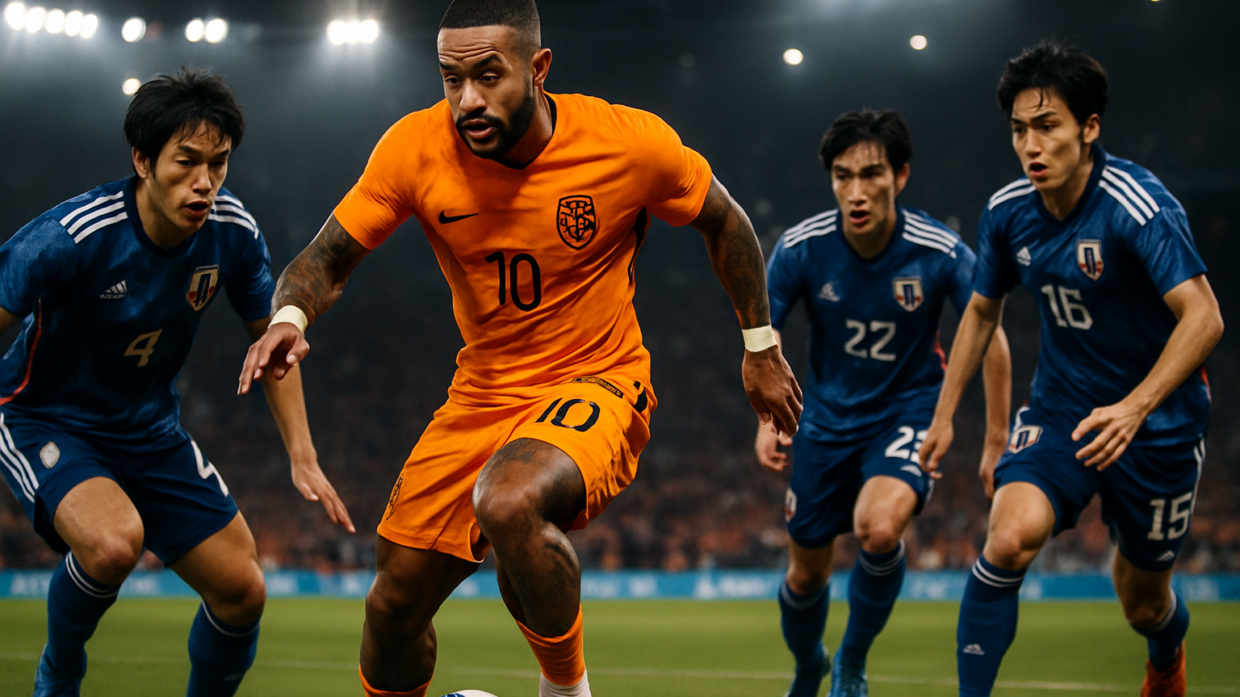
The Breakdown
The Netherlands enters this Group Stage matchup as the clear favorite based on UEFA pedigree, recent tournament performance, and tactical maturity. Ronald Koeman's side reached the 2022 World Cup quarterfinals and has maintained competitive consistency in European qualification. Their last five matches show a 3-1-1 record with victories over Turkey (2-1), Greece (3-0), and Montenegro (2-0), alongside a draw with France (2-2) and a loss to Germany (1-0). These results demonstrate both offensive capability and occasional defensive vulnerabilities that Japan will study carefully.
Japan's recent form is respectable within Asian football but pales in continental comparison. The Samurai Blue won 2-1 against Australia in 2024 World Cup qualifiers and defeated Vietnam 1-0, but losses to Croatia (1-0) in friendlies and inconsistency against top-tier opposition reveal significant gaps. Japan's squad lacks the technical refinement and game intelligence displayed by European sides, though their work rate and organizational structure cannot be ignored.
Head-to-head history slightly favors the Netherlands. The teams last met in 2019 when the Dutch won 3-0 in a friendly, with Memphis Depay scoring twice. Prior meetings in 2013 and 2010 saw the Netherlands prevail 2-1 and 1-0 respectively. No recent competitive encounter exists, but the 2019 scoreline underscores the quality gap when both teams fielded near-full strength.
Tactically, the Netherlands operates a 4-3-3 system under Koeman with high pressing intensity in midfield. Frenkie de Jong's ability to transition play from defense to attack, combined with Matthijs de Ligt's aerial dominance, creates a functional backbone. Memphis Depay's pace and finishing on the left wing, supported by Steven Bergwijn's right-side contributions, generate consistent attacking opportunities. Japan typically employs a compact 4-2-3-1 shape with defensive midfielder Wataru Endo anchoring possession and Takehiro Tomiyasu providing width. The Dutch will likely control possession with 60-65 percent, forcing Japan into reactive defense.
The Netherlands' home/away record at World Cups shows competitive equilibrium, though they benefit psychologically from European tournament experience. Japan has never advanced beyond the group stage of a World Cup, which represents significant mental baggage for their first match. Motivation differs drastically; the Netherlands targets the knockout stage immediately, while Japan plays for survival in a group that likely includes more established opposition.
Key player matchups matter significantly. De Jong versus Endo in midfield will determine possession quality. If Depay's form from club football translates to international competition, Japan's fullbacks will struggle to contain his acceleration. Conversely, Japan's attacking thrust depends on Hirving Lozano's explosive creativity from the midfield, though his consistency has wavered recently.
Injury concerns appear minimal for both sides heading into June 2026. No suspension issues currently loom over critical players. The Netherlands potentially field their strongest available XI, whereas Japan may miss influential talents depending on club season conclusions. Tactical discipline and mentality will ultimately separate these sides more than individual brilliance.
The Edge
Why Netherlands wins
- Netherlands' superior technical execution and possession control
- Defensive stability with De Ligt and established goalkeeper Andre Onana
- Depay's established goal-scoring threat against less-experienced Asian defenses
Risk factors
- Japan's compact organization can suffocate Dutch attacking rhythm in brief stretches
- Set-piece vulnerability historically exposed against organized teams
- Potential complacency as favorites allowing Japan unexpected scoring chances